
 By trendsnow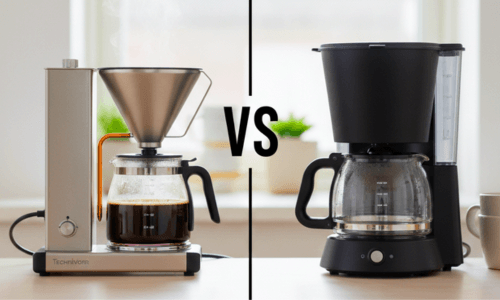
You stand in the aisle of a kitchenware store, or perhaps you are scrolling through an endless list of online retailers, staring at two distinct classes of machinery.
On one side, you see the industrial-chic silhouette of a Technivorm Moccamaster or the sleek, digital interface of a Breville Precision Brewer. These machines command prices that rival a monthly car payment—$300, $400, even $600.
Affiliate Disclosure: As an Amazon Associate, I earn from qualifying purchases. This means that if you click on a link and make a purchase, I may receive a small commission at no extra cost to you.
On the other side sits the familiar, modest plastic box: a standard drip coffee maker priced at $49.99.
Both devices make the same fundamental promise: they turn cold water and ground beans into a pot of hot coffee.
This price disparity creates the central consumer conflict of the modern coffee era.
In a world where 73% of Americans drink coffee daily and the global market for home brewing equipment has surged to a valuation of over $8 billion, the gap between “commodity” appliances and “specialty” precision tools has widened into a technological chasm.
You are asking a financial question—is the expensive one worth it?—but the answer is not financial.
The answer is rooted in thermodynamics, fluid dynamics, and organic chemistry.
While competitor landscapes often suggest that “good enough” is sufficient, and reviews argue the difference is negligible for non-professionals, we disagree. The difference is not just perceptible; it is chemical.
This report executes a forensic analysis of the home brewing market. We move beyond superficial features to dissect heating elements, showerhead geometries, and extraction physics.
By the end, you will understand exactly what you are paying for when you invest in an SCA-certified machine.
What Does an ‘SCA Certified Coffee Maker’ Actually Offer?
To evaluate the worth of a $500 brewer, you must first demystify the certification that justifies its price tag.
The Specialty Coffee Association (SCA) does not hand out the “Certified Home Brewer” mark as a marketing participation trophy. It is a rigorous scientific validation process based on decades of research into the “Golden Cup Standard”.
This standard is derived from the fundamental laws of mass transfer and solubility. Coffee brewing is, at its core, a solvent extraction process.
You are using hot water to dissolve and wash away specific chemical compounds from the cellulose matrix of the roasted bean.
The SCA standard defines the precise environmental conditions required to extract delicious compounds (sugars, fruit acids) while leaving the unpleasant ones (tannins) behind.
Don’t let your premium beans go to waste in an inefficient machine. Invest in the last coffee maker you’ll ever need to buy—handcrafted, fully repairable, and the industry standard for the Golden Cup.
Available in over 20 colors to match any kitchen aesthetic. Check current price and colors on Amazon.
1. Temperature Stability in an SCA Certified Coffee Maker
The single most critical failure point in budget coffee brewing is thermal instability.
The SCA technical standard mandates that a certified brewer must maintain water temperature in contact with the grounds between 195°F and 205°F (90.5°C–96°C) for the entire duration of the brew cycle.
This ten-degree window is a chemical requirement. Flavor compounds have different solubility coefficients relative to temperature:
- Acids (The High Notes): Vibrant, fruity, and floral notes in Arabica coffee come from organic acids like citric, malic, and phosphoric acid. If the water is too cool (below 195°F), these acids extract incompletely, leading to a sour, metallic, or “green” taste profile.
- Sugars (The Body): The sweetness and viscosity of coffee come from the caramelization of sugars, which create the cup’s “body”. This process peaks strictly within the SCA’s temperature range.
- Bitter Compounds (The Low Notes): Aggressive compounds like caffeine and phenylindanes become soluble at temperatures approaching boiling (212°F). If water “flashes” to steam—common in cheap brewers—you scorch the grounds, extracting dry, ashy flavors.
The Budget Reality: Machines under $50 rarely use capable heating elements. They rely on aluminum thermoblocks that function like flash boilers, pumping water in pulses.
The water might hit the coffee at 190°F, drop to 175°F, and then spike to steam. This results in a cup that is simultaneously under-extracted (sour) and over-extracted (bitter).
2. The Chronology of Flavor: The 4-to-8 Minute Window
Time is the second variable in the Golden Cup equation. The SCA requires that water remains in contact with the grounds for a minimum of 4 minutes and a maximum of 8 minutes.
- The Under-4-Minute Failure: If water passes through too quickly, you only extract surface compounds, resulting in a weak, tea-like body and sharp acidity.
- The Over-8-Minute Failure: If the cycle drags on—common in machines with weak pumps or calcium buildup—hydrolysis begins to break down the bean’s cellulose structure. This releases harsh, woody tannins that dominate the finish.
Budget machines often use “percolator-style” pumps that rely on boiling bubbles to lift water. If the element is underpowered, flow rates drop, extending brew times to 12 or 15 minutes, effectively “cooking” the coffee into bitterness.
3. Turbulence: The Myth of the Showerhead
Turbulence refers to the agitation of coffee grounds by incoming water. The goal is uniform saturation; every particle must be wetted simultaneously.
- The SCA Solution: Certified brewers use engineered dispersion screens. The Technivorm Moccamaster uses a 9-hole outlet arm, while the KitchenAid KCM1208 uses a 29-hole spiral. This creates a suspension where uniform extraction occurs.
- The Budget Reality: Cheap machines often use a single spout. This causes “channeling” or “tunneling,” where hot water digs a hole down the center of the bed. The center is over-washed, while the edges remain dry. You are effectively throwing away 30% of your beans because the water never touched them.
The Engineering Gap: Inside the Chassis
To understand why a $50 machine fails, we must look at the Bill of Materials (BOM) and engineering philosophy.
The Aluminum Thermoblock Bottleneck
Budget machines utilize a mechanism unchanged since the 1970s. A thin aluminum tube fused to a heating coil boils small amounts of water, pushing slugs of hot water up a pipe.
- The Flaw: This system pulses and sputters.
- The Result: A temperature profile that looks like a rollercoaster, often starting at 165°F (far too cold) and reaching target temps only at the very end. This renders the machine structurally incapable of producing sweetness.
The Plastic Problem (VOCs)
Budget brewers are constructed of injection-molded thermoplastics.
Even if labeled “BPA-Free,” lower-grade plastics can outgas Volatile Organic Compounds (VOCs) when heated, creating a persistent “new car” or chemical taste.
Furthermore, plastic is porous; over years, it absorbs rancid coffee oils and detergent residues that are impossible to scrub away.
- The Premium Difference: Machines like the Ratio Eight use borosilicate glass supply lines. The Technivorm uses high-grade aluminum and certified high-temp plastics.
The False Economy of Features
Budget machines mask engineering deficits with “feature bloat”.
You see digital clocks, “bold” buttons, and blue LEDs on $60 units. In manufacturing, every dollar spent on a digital clock is a dollar not spent on a quality heating element.
A “Bold” button typically just pulses the heater to slow flow, often leading to bitter tannin extraction rather than true strength.
The Economics: Repairability vs. Disposability
In 2026, the debate shifts from purchase price to “Cost Per Use” and sustainability.
Designed for the Dump
Most budget brewers are sealed units assembled with security screws or ultrasonic welding. If a $0.50 thermal fuse blows, the machine is non-repairable and destined for the landfill. The average lifespan is just 2 to 4 years.
Built for Life (The Modular Philosophy)
SCA-certified machines like the Moccamaster are hand-assembled using screws. Every component—from the hotplate switch to the brew basket—is a spare part. Machines from the 1980s are still in daily operation.
The 10-Year Cost Analysis
Let’s look at the math for a daily drinker over a decade:
| Cost Variable | Budget Brewer ($50) | SCA Certified (Moccamaster – $360) |
| Lifespan | ~3 Years | ~15+ Years |
| Replacements (10 Yrs) | 3 machines ($150 total) | 0 machines |
| Resale Value | $0 (Landfill) | ~$150-$200 |
| Daily Cost | $0.05 | $0.10 |
For a difference of five cents a day, the SCA brewer provides a decade of superior coffee. When factoring in the rising cost of beans ($20-$30/bag), using a cheap brewer is arguably a greater waste of money—you are burning premium fuel in an inefficient engine.
Which SCA Certified Coffee Maker Suits You in 2026?
Based on expert reviews and technical specs, here are the top contenders:
1. The Undisputed King: Technivorm Moccamaster KBGV Select (~$359)
- Best For: The Purist who values reliability.
- The Tech: Uses a copper boiling element (the gold standard) which heats water to 200°F in seconds.
- The Verdict: An industrial tool. Simple, one-switch operation. It is the only machine fully repairable at home with a screwdriver.
Check out your favorite color on Amazon.
2. The Tech-Savvy Scientist: Breville Precision Brewer (~$329)
- Best For: The Tinkerer who wants total control.
- The Tech: Uses a Thermo-Coil with PID control (digital temperature precision). You can set specific degrees (e.g., 201°F).
- The Verdict: Extremely versatile (Cold Brew, Pour-Over modes), but complex electronics generally mean lower longevity (2-year warranty) compared to the mechanical Moccamaster.
3. The Value Champion: Bonavita Connoisseur (~$150)
- Best For: The Budget-Conscious Specialty Drinker.
- The Verdict: The best “bang for your buck.” Delivers 95% of the Moccamaster’s performance, though with more plastic construction and a 3-5 year lifespan.
- The Tech: A powerful 1500-watt heater achieves thermal stability at a lower price. Includes pre-infusion modes for blooming.
Common Myths & FAQs
Can I “Hack” a $50 Machine?
Experts like James Hoffmann have shown you can improve cheap machines by filling them with boiling water or stirring the grounds manually. But this defeats the purpose. The value of an SCA brewer is automation—it performs the chemistry while you are in the shower.
Does “Supermarket Coffee” Taste Different?
If you drink dark roast pre-ground coffee (Folgers, etc.), the answer is likely no. These coffees are roasted dark to mask defects with ash and carbon flavors, which extract easily even at low temperatures. An SCA brewer is essential only when you switch to Specialty beans (Light/Medium roast), which require precise heat to unlock fruit and floral notes.
Glass vs. Thermal Carafe?
- Glass: Keeps coffee hot indefinitely but “cooks” it, creating bitterness after 40 minutes.
- Thermal: Vacuum insulation preserves flavor integrity for hours without active heat. If you drink your pot over the course of a morning, Thermal is essential.
The Verdict: Life is Too Short for Sour Coffee
The dilemma is not really about the hardware; it is about the bean.
If you view coffee as a utilitarian caffeine delivery system, a $50 budget brewer is a rational choice.
But if you buy beans with tasting notes like “blueberry,” “jasmine,” or “hazelnut,” a budget machine is actively destroying your investment. It physically cannot generate the thermal energy required to unlock the flavors you paid for.
In 2026, with the “Latte Index” rising and consumers retreating to the home, the SCA Certified Brewer is no longer a luxury; it is a necessary tool for anyone who respects the bean.
- Buy SCA Certified If: You buy whole beans, care about nuance, and want a machine that lasts 10+ years.
- Stick to Budget If: You drink dark roasts with milk/sugar and prioritize low initial cost.
Your morning cup deserves the Golden Standard.
Read more:
AeroPress Brewing: From Everyday to Exceptional