
 By trendsnow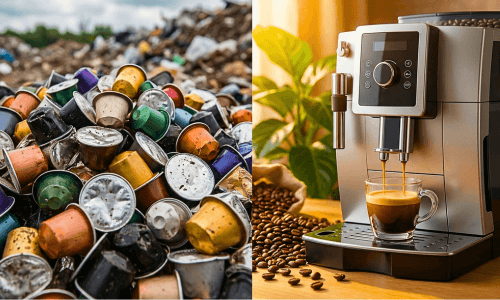
The Bean-to-Cup Coffee Machine marks a pivotal moment in the history of domestic coffee consumption.
For two decades, you have likely prioritized convenience above all else, allowing the single-serve pod system to dominate your kitchen counter.
Affiliate Disclosure: As an Amazon Associate, I earn from qualifying purchases. This means that if you click on a link and make a purchase, I may receive a small commission at no extra cost to you.
Companies built empires on the promise of zero effort, but the landscape of 2026 is radically different. The era of disposable consumption is ending.
Sustainability is no longer a buzzword you can ignore; it is a mandatory operational requirement driven by legislative pressure and a fundamental shift in your own consumer psychology.
But beyond the environmental guilt, there is a hard financial reality. Data from 2025 reveals that 55 percent of coffee drinkers now express deep concern over the sustainability and cost of their brewing methods.
Reclaiming Your Ritual: The Bean-to-Cup Coffee Machine Advantage
You are likely part of this demographic, looking for a way to align your daily ritual with your values.
The shift to a Bean-to-Cup Coffee Machine—whether it is a super-automatic like the Philips 3200 or a versatile powerhouse like the Ninja Luxe Café Pro—represents a return to sanity.
By switching to a machine that grinds fresh beans for every cup, you reclaim control over your budget, your environmental footprint, and the quality of your morning caffeine kick.
This report provides the exhaustive data you need to make that switch and proves why the pod era is officially over.
The Economic Reality: Bean-to-Cup Coffee Machine vs. Pods
The primary barrier to entry for many people is the upfront price. You likely bought your pod machine because the entry price was low.
You saw a Keurig for $70 or a Nespresso Vertuo for $150 and it seemed like a bargain compared to a $600 Bean-to-Cup Coffee Machine. This is the classic “razor and blades” business model designed to trap you in a cycle of perpetual micropayments.
To understand the true value, you must look at the Total Cost of Ownership (TCO) over a five-year period.
The High Cost of Convenience
When you purchase a Nespresso Vertuo pod, you pay between $0.90 and $1.25 per serving. If you drink two cups a day, you spend nearly $900 a year just on coffee.
Over five years, that totals more than $4,500. You are effectively paying $50 to $60 per pound for coffee that is often stale and made from lower-grade commodity beans.
The Savings of a Bean-to-Cup Coffee Machine
Contrast this with a high-quality Bean-to-Cup Coffee Machine like the Philips 3200 or De’Longhi Magnifica Evo. You might spend $450 to $600 upfront.
However, you can buy excellent fresh-roasted specialty beans for approximately $0.25 to $0.45 per cup, depending on the bean quality.
Even buying premium SCA Certified beans at $32.55 per pound results in a lower cost per cup than a standard pod. The math is undeniable.
You break even on the Bean-to-Cup Coffee Machine cost within 12 to 18 months. After that point, you save hundreds of dollars every year.
You also insulate yourself from “shrinkflation,” where pod manufacturers reduce the gram weight of coffee in each capsule while keeping prices stable.
5-Year Ownership Cost Breakdown:
- Nespresso Vertuo System: ~$4,560.00
- Keurig K-Cup System: ~$2,655.00
- De’Longhi Dinamica (Bean-to-Cup): ~$1,895.00
- Philips 3200 (Bean-to-Cup): ~$1,362.50
You can see that even the most expensive Bean-to-Cup Coffee Machine options are vastly cheaper than the Nespresso ecosystem over five years.
You save over $2,700 by choosing a Ninja Luxe Café Pro over a Vertuo system. This is money you could invest, save, or spend on even better coffee beans.
Why a Bean-to-Cup Coffee Machine Delivers Superior Flavor
You might wonder what creates the massive quality gap between pods and fresh ground beans. You might believe that the coffee in a pod is “fresh” because it is sealed in aluminum. This is a marketing fabrication.
The Freshness Factor
Because they are an agricultural product, coffee beans lose quality over time. When roasted, they release carbon dioxide (degassing) and volatile aromatic compounds.
These aromatics are what you taste and smell. When coffee is ground, the surface area increases exponentially, and oxidation happens in minutes.
Pod manufacturers grind the coffee, let it stale (degas) so the pod does not explode, and then seal it. You are drinking coffee that lost its peak flavor months ago.
A Bean-to-Cup Coffee Machine grinds the beans immediately before brewing, preserving those volatile compounds for your cup.
The Dosage Difference
Furthermore, you must consider the dose. A Nespresso Original capsule contains only 5 grams of coffee. To make this tiny amount of coffee taste strong, manufacturers over-roast it (making it bitter) and rely on high-pressure extraction.
A standard double shot of espresso from a Bean-to-Cup Coffee Machine uses 18 to 20 grams of coffee. You get four times the raw material. This allows for a balanced extraction where you taste chocolate, fruit, and caramel notes, not just “strong coffee” flavor.
The “crema” on a Vertuo coffee is often just foam created by spinning the capsule, whereas true crema from a Bean-to-Cup Coffee Machine comes from the pressure forcing oils out of fresh beans.
Environmental Impact: Pods vs. Bean-to-Cup Coffee Machine
In 2026, the environmental cost of single-serve brewing is catastrophic compared to whole beans. Research confirms that coffee pods produce 10.92 kg of CO2 equivalent per 100 servings. Ground coffee produces only 6.61 kg.
That is a 65% increase in your carbon footprint just for convenience.
The Waste Crisis
You generate waste at every step with pods. The aluminum must be mined, the plastic synthesized, and the pods manufactured and shipped. Finally, you discard them.
Even if you use the recycling bag, many municipal centers reject pods because they are too small and contain mixed materials. In 2026, 56 billion pods enter landfills annually.
Switching to a Bean-to-Cup Coffee Machine eliminates this entirely. Your only waste is the coffee grounds. These are organic.
You can compost them in your garden or put them in your municipal green bin. They return nitrogen to the soil. It is a circular system.
Top Bean-to-Cup Coffee Machine Models Defining 2026
You might fear that ditching pods means more work. You envision messy grounds and complicated tamping. Super-automatic machines like the Philips 3200 LatteGo solve this. They are true robots for your kitchen.
Philips 3200 LatteGo
This machine specifically targets the friction points of maintenance. Its LatteGo milk system has only two parts and no internal tubes.
You can clean it under a tap in 15 seconds. You pour beans in the top, press one button, and the Bean-to-Cup Coffee Machine grinds, tamps, brews, and ejects the waste puck internally.
Ninja Luxe Café Pro
Prosumer coffee lovers seeking versatility will find the Ninja Luxe Café Pro transformative. A master of many functions, it integrates a conical burr grinder with an advanced grind‑by‑weight scale.
This feature, typically found on commercial grinders, ensures you use the exact gram dose of coffee every single time.
It also addresses the cold brew trend. Traditional cold brew takes 12 to 24 hours. The Ninja Luxe Café Pro uses a rapid extraction technology to deliver a cold brew concentrate in under three minutes.
It bridges the gap between the manual ritual of a portafilter machine and the push-button ease of a robot.
Ninja Luxe Café Pro vs. Competition:
- Grinder Tech: Grind-by-Weight (Ninja) vs. Time-Based (Breville).
- Cold Brew Speed: < 3 Minutes (Ninja) vs. Not Available (Breville).
- Tamping: Auto-Assist (Ninja) vs. Manual (Breville).
Transitioning to a Bean-to-Cup Coffee Machine
You need a plan to switch. It can be intimidating to leave the simple world of color-coded capsules. Follow this transition guide to ensure your success with your new Bean-to-Cup Coffee Machine.
Step 1: Choose Your Tier
- Tier 1 (Convenience): Super-Automatic (e.g., Philips 3200). Best for latte/cappuccino lovers who hate cleanup.
- Tier 2 (Versatility): All-in-One (e.g., Ninja Luxe Café Pro). Best for households that drink cold brew, drip, and espresso.
Step 2: Buy the Right Beans
Do not buy cheap grocery store beans. They are often stale. Find a local roaster or a subscription service. Look for a “Roast Date” on the bag and use beans within 4-6 weeks of roasting.
Step 3: Dial In
Your first cup might not be perfect. If it tastes sour, grind finer. If it tastes bitter, grind coarser. Pod machines deny you this control; a Bean-to-Cup Coffee Machine demands it. Spend one weekend morning testing 2-3 settings. Once set, you rarely need to change it.
Frequently Asked Questions About the Bean-to-Cup Coffee Machine
Is a Bean-to-Cup Coffee Machine hard to clean?
No. You need to empty the dregs bin (spent coffee) every 8-10 cups and fill the water tank. Once a week, you should rinse the brew group (for Philips/De’Longhi). Once every 2-3 months, you need to descale it. It is more work than a pod, but only by a few minutes a week.
What is the best machine for a former Keurig user?
If you want zero learning curve, the Philips 3200 is the closest experience to a Keurig but with fresh beans. You press a button, and it makes coffee. It offers the convenience of a pod machine with the quality of a Bean-to-Cup Coffee Machine.
Why does the SCA certification matter?
If you opt for a drip-style Bean-to-Cup Coffee Machine or a precision brewer, SCA certification guarantees the machine heats water to 195°F–205°F. Standard machines often brew at 175°F, resulting in sour, underextracted coffee.
Conclusion: The Era of the Bean-to-Cup Coffee Machine
You have seen the numbers. You have seen the environmental scars. You have seen the technology that renders the pod obsolete. 2026 is the year you stop settling for mediocrity.
The hidden costs of single-serve brewing—the drain on your wallet, the mountain of waste in the landfill, and the stale taste in your cup—are no longer secrets.
The Bean-to-Cup Coffee Machine offers you a better path. It offers you the dignity of a fresh cup, brewed correctly, for a fraction of the price over time.
Do not let convenience rob you of quality. Do not let plastic define your morning. Make the switch to a Bean-to-Cup Coffee Machine today. Your wallet will recover.
The planet will breathe a little easier. And your coffee will finally taste like coffee!
Read more:
AI in Coffee Brewing: The Future of Your Morning Ritual