
 By trendsnow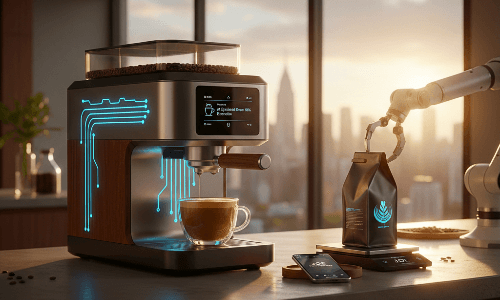
AI in Coffee Brewing is redefining how we experience our daily caffeine, as home espresso machine ownership has grown by 50 percent since 2020.
The landscape of the American kitchen has shifted dramatically, and this massive change in consumer behavior means you no longer need years of professional training to enjoy a professional latte.
Affiliate Disclosure: As an Amazon Associate, I earn from qualifying purchases. This means that if you click on a link and make a purchase, I may receive a small commission at no extra cost to you.
Modern technology now handles the complex variables of extraction.
By integrating sensors and algorithms, high-end prosumer machines can replicate the skills of a seasoned barista, transforming your morning ritual through the power of artificial intelligence.
How AI in Coffee Brewing Solves the Human Error Problem
Traditional espresso preparation is notoriously difficult, requiring mastery over seven different variables: grind size, dose weight, water temperature, water pressure, tamping force, extraction time, and water quality.
A single mistake in any of these areas produces a sour or bitter cup. However, the rise of AI in Coffee Brewing is eliminating this margin for error.
Smart machines now integrate sensors that track the flow of water through the coffee puck in real time.
If the water flows too quickly, the internal computer identifies an under-extracted shot.
The machine then creates a feedback loop, suggesting a finer grind for your next cup to ensure a high-quality floor for every beverage you make.
This technology saves you time and money by preventing the waste of expensive beans during the “dial-in” process.
Precision Engineering: The Mechanical Side of AI in Coffee Brewing
While technology cannot yet smell or taste the coffee, it monitors the mechanical data that leads to those sensory experiences.
Several innovative systems are leading this charge:
1. The Challenge of Tamping
Tamping—the process of compressing grounds into a flat disc—often frustrates beginners. If you tamp at an angle, water finds a path of least resistance, creating channeling which ruins the flavor.
The AI in Coffee Brewing within the Breville system solves this via the Impress Puck System.
- It uses an assisted tamping lever to deliver exactly 22 pounds of pressure, the professional standard.
- It performs a 7-degree barista twist at the end to polish the surface and ensure even water distribution.
- Its intelligent dosing sensor achieves consistency within 0.5 grams, rivaling commercial equipment.
Check price of the Breville Barista Express Impress on Amazon.
2. The Jura Z10 and Product Recognition
The Jura Z10 utilizes a Product Recognizing Grinder (PRG) that adjusts in a fraction of a second.
- The AI recognizes the specific drink you select on the touchscreen.
- It automatically sets the burrs to a fine position for espresso or a coarse setting for long coffee.
- It also features a Cold Extraction Process, pulsing cold water at high pressure to create a genuine cold brew concentrate in under two minutes.
IoT Connectivity and the AI in Coffee Brewing Ecosystem
Your coffee maker is no longer just an appliance; it is a connected node in your kitchen ecosystem. Manufacturers include Wi-Fi and Bluetooth modules to meet the growing demand for convenience. This connectivity allows you to:
- Remote Brew: Start your morning brew from your bed using a smartphone.
- Custom Profiles: Use apps like J.O.E. or SmartHQ to adjust the strength, volume, and temperature of your espresso.
- Automated Maintenance: The machine tracks water and coffee processing to send proactive alerts when you need to change a filter or run a cleaning cycle.
Beyond the kitchen, the next level of AI in Coffee Brewing involves the supply chain. Some smart machines track your bean consumption and can automatically order a new bag from your favorite roaster when you run low.
Since freshness is the most important factor in espresso quality, this ensures you always have peak-quality ingredients.
Comparison of Leading AI in Coffee Brewing Systems
| Machine Model | Core AI Technology | Primary User Benefit | Best For |
| Breville Barista Express Impress | Impress Puck System | Eliminates tamping and dosing errors | Beginners who want a “hands-on” experience without the frustration. |
| Jura Z10 | Product Recognizing Grinder (PRG) | One-touch variety from espresso to cold brew | Lovers of variety who want luxury and speed. |
| GE Profile Smart Brew | SmartHQ App Integration | Voice commands and remote scheduling | Smart home enthusiasts who prioritize convenience. |
| Fellow Aiden | Temperature Profiling | Mimics the precision of manual pour over | Drip coffee purists who want the “Gold Cup” standard. |
Looking Ahead: The Future of AI in Coffee Brewing
By 2026, the global market for smart kitchen appliances is predicted to reach 50 billion dollars.
We are already seeing the rise of robotic baristas that use machine learning to optimize every step, including pouring complex latte art with perfect precision.
Future innovations in AI in Coffee Brewing will likely include:
- Computer Vision: Cameras that analyze the color and viscosity of the espresso stream to stop the flow if it turns “blonde” too early.
- Modular Design: Systems that allow you to swap out specific parts like the grinder or milk system, making machines easier to repair and more sustainable.
- Carbon Tracking: Helping users make mindful, eco-friendly consumption choices.
Common Questions About AI in Coffee Brewing
Is a smart machine harder to clean?
Actually, they are often easier. Most feature automated cycles that handle internal rinsing, such as the Jura Z10’s one-touch milk system cleaning.
Do I need a fast Wi-Fi connection?
No, the brewing functions do not require the internet. You can still make espresso manually if your Wi-Fi is down; the connection is only for advanced features like remote commands and maintenance alerts.
Can I still learn barista skills?
Yes. Many smart machines, like the Breville Barista Touch Impress, act as tutors. They provide step-by-step guidance on grind settings and dose amounts, helping you understand the science while giving you the option to switch to manual mode as your skills improve.
Embracing the Precision of AI in Coffee Brewing
The evolution of AI in Coffee Brewing proves that the ritual of coffee is not disappearing; it is simply becoming more precise.
While the human touch remains a valuable art form in the world of specialty coffee, smart machines provide a level of reliability and consistency that modern home users crave.
By monitoring every extraction and alerting you to every maintenance need, these intelligent tools ensure that you enjoy a perfect cup every single morning.
As we move toward a future where machines can “see” the extraction and modular designs make repairs easier, the barrier to entry for professional-quality espresso has never been lower.
Whether you are a beginner looking for guidance or an expert seeking technical perfection, AI in Coffee Brewing serves as the ultimate assistant in your journey toward coffee excellence.
Ready to upgrade your home barista setup?
If you want to stay updated on the latest shifts in coffee technology and find the best equipment for your kitchen, we are here to help.
Subscribe to our email list to receive our newest articles, expert guides, and deep dives into the science of brewing directly in your inbox.
Read also:
SCA Certified Coffee Maker vs Cheap Models: Is It Worth It?